.webp)



BLOG
Case Study
Global Employee Benefits: A Practical Guide for International Employers
September 2, 2026





TL;DR:
Disclaimer: This guide provides general information, not legal, tax, or employment advice. Statutory benefits and employment obligations vary by country, employee classification, industry, and individual circumstances. Employers should always obtain qualified local advice before hiring.
There's no such thing as a universal benefits package. Legally required global employee benefits are the country-specific minimums, set by local labor law, that a full-time employee is entitled to regardless of where the company is headquartered.
This guide covers required benefits for full-time employees globally: what "legally required" actually means, why the answer changes by country, what happens if you skip it, and how to choose the right benefits beyond the minimum. You won't come away a labor lawyer for 190 countries. You'll come away knowing what to check before you make an offer.
US employers must provide the statutory benefits of whatever country their employee actually works in. Employment law and benefits obligations travel together: if you hire someone who lives and works in Germany, German law and German statutory benefits apply, regardless of where your company is incorporated.
This trips up first-time international employers more than almost anything else. Most international health insurers won't cover US-based plans, retirement plans are typically tied to a country's own tax infrastructure, and local law usually requires enrollment in that country's own social security scheme regardless of what the employer offers on top.
This holds true whether you hire through a local entity, an EOR, or misclassify the role as a contractor. Misclassification doesn't remove the obligation; it just delays the bill, often with penalties attached once it's discovered.
How much you owe in each market comes down to what that country's government has built into its own social protection system. A country with strong universal healthcare, like the UK, places less of that burden directly on employers.
A country without one, like the US, often shifts more of that cost onto the employer relationship instead. Here's how it plays out across five common hiring markets. Here's how it plays out across four priority hiring regions.
The US sets no federal floor for paid leave, and the main statutory obligation employers face is health coverage.
Latin America layers statutory obligations on top of base salary rather than folding them into it, which is why employer costs there often run higher than they first appear.
For the full breakdown against contractor arrangements, see Athyna's guide to contractor vs. full-time employee in Latin America.
European statutory leave tends to be more generous than the US baseline, and it applies uniformly regardless of company size.
Southeast Asia follows a pattern closer to Latin America's than the US or UK: mandatory contributions and bonus pay stack on top of base salary.
The hiring model you choose determines who is legally responsible for delivering statutory benefits. Three structures dominate international hiring, each with a different compliance load.
Athyna's guide on whether you need an Employer of Record to hire in Latin America walks through how to decide between these models.
A US company can offer supplemental benefits on top of what's legally required, but it can't replace a foreign country's statutory benefits with a US-style plan. Most US health and retirement plans aren't built to operate abroad, and local law generally requires enrollment in that country's own statutory schemes regardless of what else is offered.
A legally required benefit, also called a statutory or mandatory benefit, is any form of compensation beyond base salary that a government mandates by law. It's not optional and not something an employer can substitute with a nicer perk.
Statutory benefits guarantee a baseline of income security, health protection, and time off, and they apply the moment someone is classified as an employee, not a contractor.
Most international hiring guides stop at that definition and move to a country list, skipping the part that determines what you actually owe: not every benefit falls into the same bucket. Athyna groups benefits into three tiers, and treating them as interchangeable is where most compliance mistakes start.
Every benefit a full-time employee receives falls into one of three tiers, and where it falls determines whether you're required to offer it, obligated to once you've promised it, or simply choosing to.
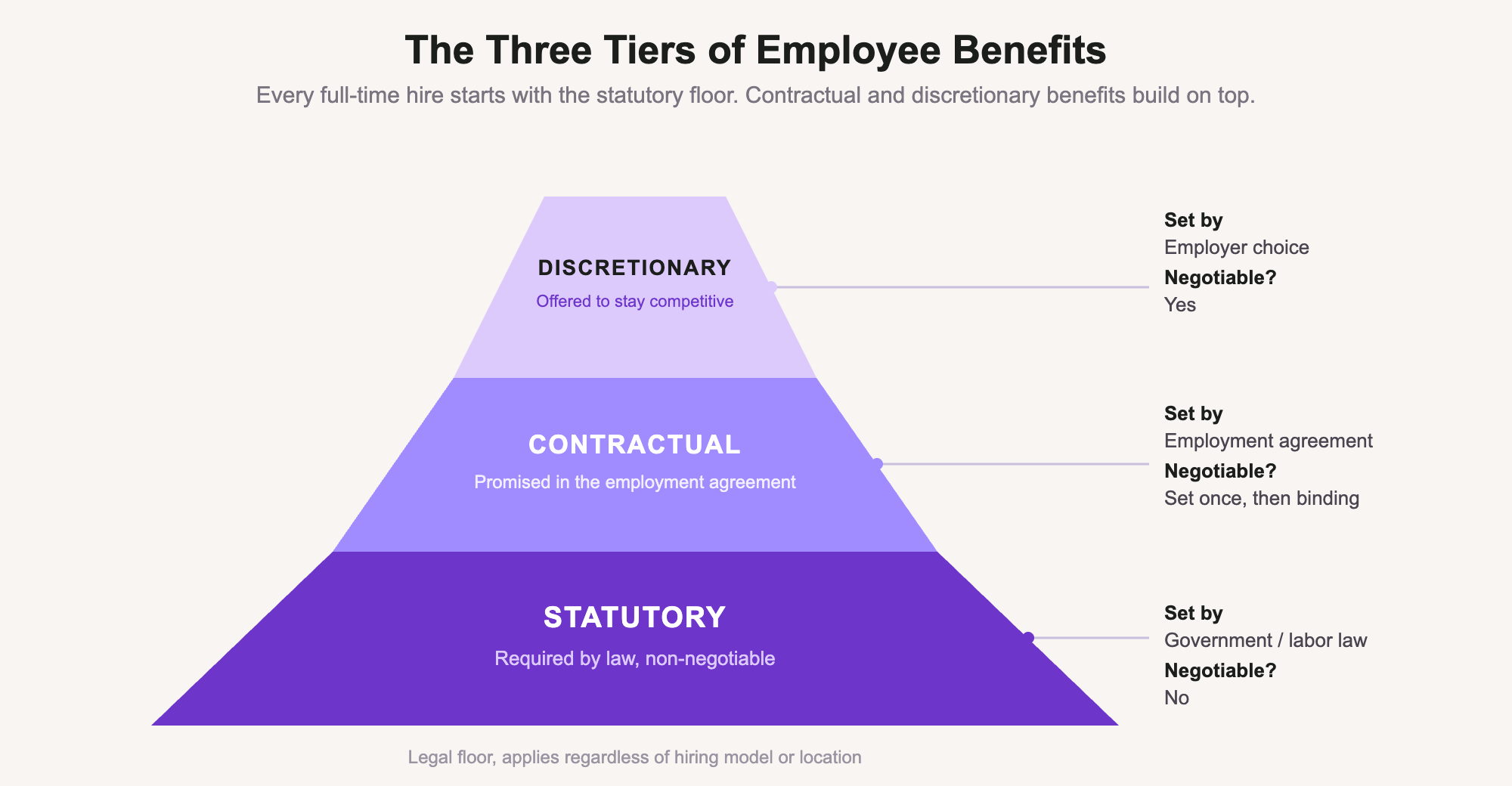
The practical value shows up the moment you expand into a new country. Instead of asking "what benefits do we offer," ask "what does this country's law require, what have we promised in the contract, and what do we want to offer to stay competitive." Those are three separate budgets, and conflating them is how companies end up overpromising or underdelivering.
Skipping statutory benefits doesn't save money; it defers a liability that usually comes back larger. Consequences cluster around a few consistent outcomes: back payment of everything owed, financial penalties on top of that, and in some jurisdictions, personal exposure for company officers. The scale can be significant.
Spanish authorities determined that food delivery company Glovo had misclassified more than 17,000 workers as self-employed contractors rather than employees, resulting in €253 million in penalties and social security claims.
In the US, a large employer that fails to offer minimum essential health coverage to substantially all full-time employees faces a penalty of $3,340 per employee for 2026, after excluding the first 30, according to the IRS's 2026 employer shared responsibility payment update.
This isn't exotic risk reserved for large multinationals. It's the default exposure for any company that hires its first international employee without checking local law first, and it compounds with back-dated audits and legal fees the longer it goes unnoticed.
Meeting the statutory minimum keeps you compliant. Retention is a different question, one shaped by what candidates in a given market already expect from a good employer, not by what's standard at your headquarters.
Statutory benefits set the legal floor, and every employer in that market meets it, so it's not what makes anyone choose you. Retention gets decided above that floor: budgeting for only the statutory minimum in a market where private health coverage is table stakes will show up in your offer acceptance rate before it shows up in a compliance audit.
Going beyond the floor doesn't mean guessing. It means finding out what a strong local employer already offers before you write the job description, then matching or beating it where it matters most to that specific talent pool. A wellness stipend might be the deciding factor in one market and an afterthought in another, the point is knowing the difference before you make the offer, not after a candidate turns it down.
Most companies manage this by researching what's genuinely competitive in each market before extending an offer, then keeping a consistent process for adapting benefits by country rather than reinventing the package for every hire. Centralizing that research through a single partner removes the guesswork of figuring out local expectations market by market.
The next section breaks down which discretionary benefits tend to move the needle most, regardless of country.
Beyond the statutory floor, the benefits that actually help you win and keep international talent tend to fall into a fairly consistent set, regardless of country. These are discretionary, so nothing here is legally required, but skipping them in competitive markets shows up in offer acceptance and retention rates rather than in a compliance audit.
The right mix depends on the country and the role, which is exactly why this list works better as a starting menu than a template applied the same way everywhere.
If you're planning your next international hire and want the compliance layer handled without building it yourself, get in touch with the Athyna team!

Athyna's content specialists covering global hiring and AI training trends for growing teams.
.svg)
Legally required global employee benefits are country-specific forms of compensation and protection that employers must provide under local labor law. They commonly include statutory paid leave, social security contributions, health coverage, retirement contributions, severance protections, and mandatory bonus payments.
Yes. A US employer generally needs to meet the statutory employment benefit requirements of the country where an international employee lives and works. For example, a US company employing someone in Germany must follow German employment rules and benefit obligations.
Statutory benefits are required by law, contractual benefits are promised in an employment agreement, and discretionary benefits are optional benefits an employer chooses to offer.
Statutory benefits are non-negotiable and can include paid leave, social security contributions, and severance protections. Contractual benefits become legally binding once included in an employee's contract. Discretionary benefits, such as private health insurance, learning budgets, and home-office support, help employers compete for and retain talent above the legal minimum.
An employer that fails to provide legally required benefits can face back payments, fines, legal fees, and employee misclassification claims. The liability can grow over time because authorities may require the employer to correct past payroll, social security, leave, and benefit obligations.
For international employers, treating an employee as a contractor does not remove this risk if the working relationship meets the local legal definition of employment. The safest approach is to confirm the correct classification and statutory benefit obligations before making an offer.
Companies should first meet every statutory benefit requirement in the employee's country, then add benefits that match local market expectations and the needs of the role. Legal compliance creates the baseline. Competitive benefits help the company attract and retain talent.