


BLOG
Case Study
How Native Speakers Train Audio AI to Sound Human
August 16, 2026





TL;DR
Audio AI learns from the native speakers who transcribe those files, judge whether a synthesized response sounds natural, and catch the pronunciation errors a model doesn't know it's making. It doesn’t learn to sound human from audio files alone.
This layer of human language expertise, spanning speech data annotation, pronunciation assessment, and real-world quality checks, is what separates a voice AI system that merely functions from one that people trust. Here's how that work actually happens, and why it can't be automated away.
Raw audio data teaches a model what sound patterns exist, not what they mean to the people speaking them. A speech recognition system fed only recordings, without native-speaker transcription, dialect labeling, and intent tagging, has no reliable way to tell a Colombian Spanish speaker's phrasing apart from a Mexican Spanish speaker's, or to catch that "boludo" is an insult in some contexts and a term of affection between friends in others.
That gap shows up fast once a product ships. A 2023 study on user trust after voice assistant failures, presented at the ACM CHI conference, found that when users believed a transcription failure happened because they were speaking a language the device wasn't built for, they stopped using the assistant in that language entirely, even when they kept using it normally for others.
Users don't just hear what an AI says. They hear how it says it, and whether it sounds like it understands the room it's in. That distinction is a data problem before it's a model problem**. Without reliable regional and dialect labels, teams risk training on data that treats meaningful language differences as noise or error, which is exactly the gap native speakers for speech AI training are meant to close.** It's the same underlying principle behind why language expertise shapes better models more broadly, just applied to the specific demands of speech.
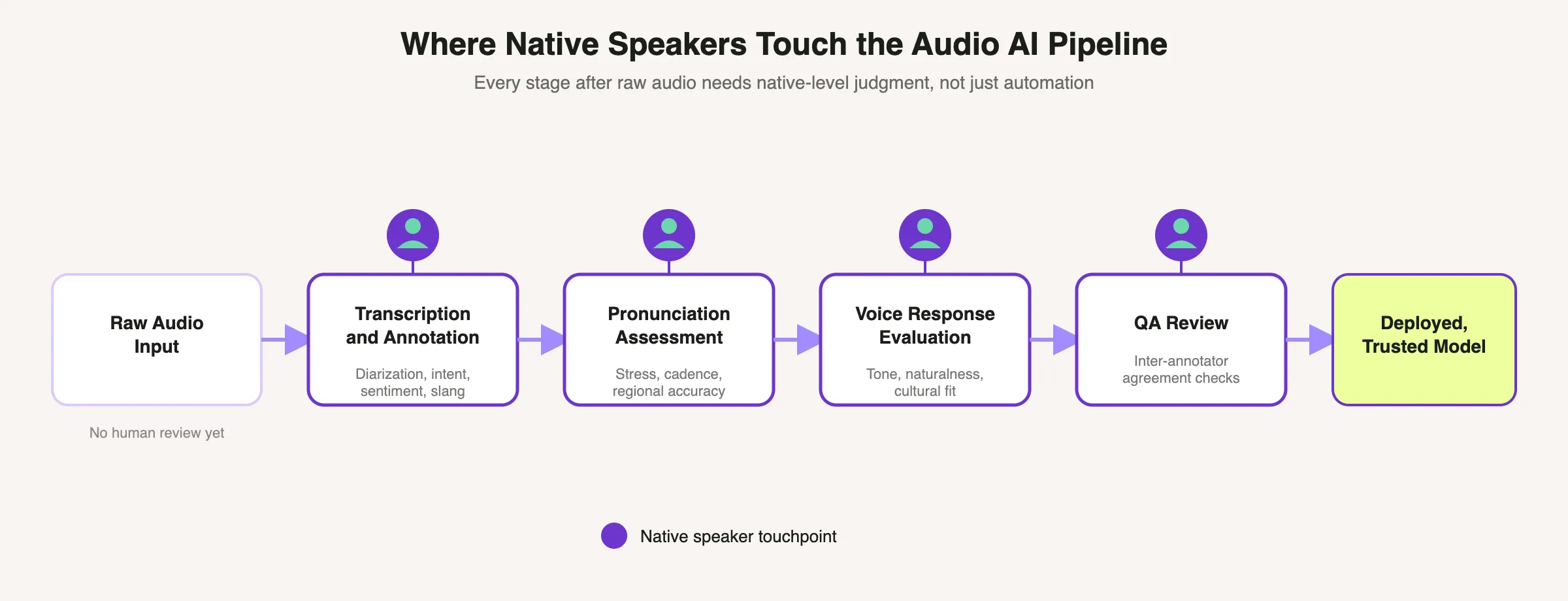
Native speakers train Audio AI by transcribing speech data, labeling accents and dialects, tagging intent and emotion, and flagging the idioms and code-switching patterns that a non-native annotator would miss or mislabel. This work sits at the core of audio transcription and annotation pipelines and happens at nearly every stage, not just at the end, splitting into a handful of distinct tasks:
Language shifts faster than dictionaries or style guides can track it, especially online, and a model trained without that shifting vocabulary starts to sound dated the moment it ships.
Pronunciation assessment is the practice of native speakers judging whether a spoken utterance, human or AI-generated, matches how a word is actually said in that language and region, not just whether it matches a dictionary phoneme sequence. It's a distinct skill from general transcription, and most Audio AI content treats it as a footnote inside "accent labeling" instead of its own discipline.
The distinction matters because pronunciation errors are often invisible to automated scoring. A speech recognition system can transcribe a word correctly from an unusual pronunciation and still fail the user, because the model never learned that pronunciation as a valid variant in the first place.
Researchers at the University of Tokyo studying second-language pronunciation have used native-speaker shadowing, where a native listener immediately repeats what they heard, as a more reliable intelligibility signal than automatic speech recognition scoring alone. Breakdowns in a human listener's shadowing reveal problems that word-error-rate metrics miss entirely.
For companies building multilingual voice products, pronunciation review needs its own workflow, not a line item inside general accent QA. A native Portuguese speaker assessing a Brazilian Portuguese TTS voice listens for stress patterns, vowel reduction, and regional cadence that a general fluency check would pass right over.
Native speakers evaluate AI voice responses by rating how natural, culturally appropriate, and emotionally accurate a generated response sounds, not just whether the words are technically correct. This is a separate evaluation layer from input-side transcription, and it's where most Audio AI content stops short.
A transcript can be perfect, and the response can still fail. Hume AI, whose Real World VoiceEQ benchmark is one of the largest human-evaluation efforts on this problem, points out that a confident "yes" and a hesitant "yes" carry different meanings even when the transcript reads identically. Only a human listener catches tone, hesitation, or a mismatched register between what a voice assistant says and how it says it.
The scale of that benchmark shows how much human judgment this actually takes: more than 785,000 human ratings of text-to-speech output and 48,000 ratings of speech-to-speech interactions, collected specifically because acoustic qualities like tone and emotion don't show up in a text transcript at all.
Evaluating voice responses well means building language-specific test sets, not translating one English rubric across markets. Teams building multilingual voice agents typically record native speakers asking real, common questions in each target language, then score the AI's responses for accuracy, latency, and whether the reply is culturally appropriate in that specific market, not just technically correct in translation.
A generated response can nail every word and still land wrong if the phrasing is formal where the culture expects casual, or blunt where the culture expects softened delivery.
Training multilingual speech AI requires several distinct native-speaker roles, not one generalist annotator role stretched across every task in a voice AI training pipeline. Each role maps to a different point in the pipeline and needs different judgment.
A team launching a voice product into a new market needs coverage across every one of these roles for that language. Skipping the QA reviewer role in particular is a common mistake, and it's one of the most frequent gaps we see when teams are hiring the right AI model training specialist for a voice product.
Without someone auditing agreement between annotators, small labeling inconsistencies compound silently until they surface as accuracy gaps in production, months after the dataset shipped. Each of these roles is a specialized version of what an AI trainer does more broadly, adapted for the specific demands of audio.
Vetted native specialists and anonymous crowdsourced labeling produce noticeably different data quality, even when both pools claim native-level fluency on paper. The difference comes down to how "native" gets verified.
Large-scale crowdsourcing platforms have volume, which matters for simple, high-repetition tasks. But volume isn't depth. A general freelancer marketplace usually screens for baseline language proficiency, not native-level judgment in a target dialect, which is why vetting criteria for AI trainers need to go further than a standard language test.
That gap is exactly where Audio AI accuracy problems tend to originate: not in the model architecture, but in a dataset built by annotators who were fluent enough to pass a screening test and not native enough to catch the nuance the product needed.
Companies can hire native speakers for AI training through general crowdsourcing marketplaces, specialized data-annotation vendors, or a vetted talent platform built to source native language experts for AI, matched directly to a product's language and domain needs. The right choice depends on how much quality control the team wants to own itself.
Latin America has become a strong source for this work specifically, particularly for companies training Spanish, Portuguese, or bilingual English products, and it's why LatAm hiring platforms have grown so quickly over the past few years. The region produces native Spanish and Portuguese speakers with real academic depth in linguistics, computer science, and NLP, working in time zones close enough to US teams for live QA loops and same-day feedback cycles, without the anonymous, task-by-task setup of a general crowdsourcing pool.
That's the gap Athyna Intelligence is built to close. Athyna matches companies with PhDs and domain experts from Latin America for AI training work, including audio annotation, pronunciation and voice-response evaluation, and multilingual quality assurance, with a human team involved through vetting, onboarding, and delivery rather than an anonymous task queue.
The goal isn't just access to native speakers. It's access to native speakers whose judgment has already been checked before a project starts.
Audio AI will keep getting better at converting sound into text. What decides whether it sounds trustworthy, natural, and right for the market it's serving still comes down to the native speakers reviewing it, one utterance at a time. If your team is scaling multilingual voice AI and needs that layer of native-language judgment, Athyna Intelligence can help you find it.

Athyna's content specialists covering global hiring and AI training trends for growing teams.
.svg)
Native speakers train Audio AI by transcribing speech, labeling dialects and accents, identifying intent and emotion, and flagging slang, idioms, and code-switching. They also evaluate generated voice responses for naturalness, pronunciation, tone, and cultural fit. Their judgment helps models handle the language people actually use, not only standardized examples.
Native-speaker review catches language and cultural errors that automated metrics and non-native annotators can miss. A model may transcribe words correctly but still misunderstand regional phrasing, pronounce a word unnaturally, or use the wrong emotional tone. Native reviewers help teams identify these failures before they affect users in production.
Pronunciation assessment is the process of evaluating whether human or AI-generated speech sounds correct and natural for a specific language and region. Native evaluators listen for details such as stress, vowel sounds, cadence, and regional variation. This goes beyond checking whether speech is technically intelligible or matches a dictionary pronunciation.
A multilingual speech AI program typically needs native transcribers and annotators, pronunciation evaluators, voice response raters, linguistic QA reviewers, and domain specialists when the product serves regulated or technical industries. Each role assesses a different part of the pipeline, from raw audio accuracy to whether a generated response sounds appropriate in a real conversation.
Companies can hire native speakers through crowdsourcing marketplaces, specialized data-annotation vendors, or vetted talent platforms. The best option depends on the required quality control, language coverage, and domain expertise. For speech products where regional nuance and consistent QA matter, teams should prioritize specialists verified for the relevant language, dialect, and use case.