

AI training & trends
What is Terminal-Bench 4.0, and how does it compare with 2.0?







Terminal-Bench 4.0 is the next step in the Terminal-Bench series, built to measure how AI agents handle a broader and harder set of real technical work. Like 2.0, it checks completed work with automated tests instead of relying on an agent’s own report of success. What changed is the task set and the evaluation criteria, which is why leaderboard scores from the two versions sit on different scales.
For AI labs building agents for benchmarks like this, Athyna provides expert-built training datasets and the specialists behind them.
Terminal-Bench is a public benchmark that tests how well AI agents complete real-world tasks in a command-line terminal. The project is hosted by Stanford University, the Laude Institute, and Harbor, with tasks created and reviewed by individuals and organizations listed on the official contributors page.
Each task gives the agent written instructions and an isolated environment with the files and tools needed for the job. The agent works through the problem by inspecting files, running commands, and making changes in the terminal.
After the agent finishes, a verifier runs automated tests to determine whether the work meets all required checks. The agent's own report of success doesn't count toward the result. Each task also includes a human-written reference solution that demonstrates the work is achievable, as documented in the Terminal-Bench paper.
Terminal-Bench is an example of model evaluation, a process distinct from training methods such as reinforcement learning from human feedback (RLHF) and supervised fine-tuning (SFT). Our guide to RLHF, SFT, and model evaluation explains how these approaches differ.
Terminal-Bench 2.0 is an agentic coding benchmark at heart, testing how well AI agents completed difficult technical tasks in a terminal, with software engineering as its largest category. Released in November 2025, it included 89 tasks selected from 229 submissions by 93 contributors.
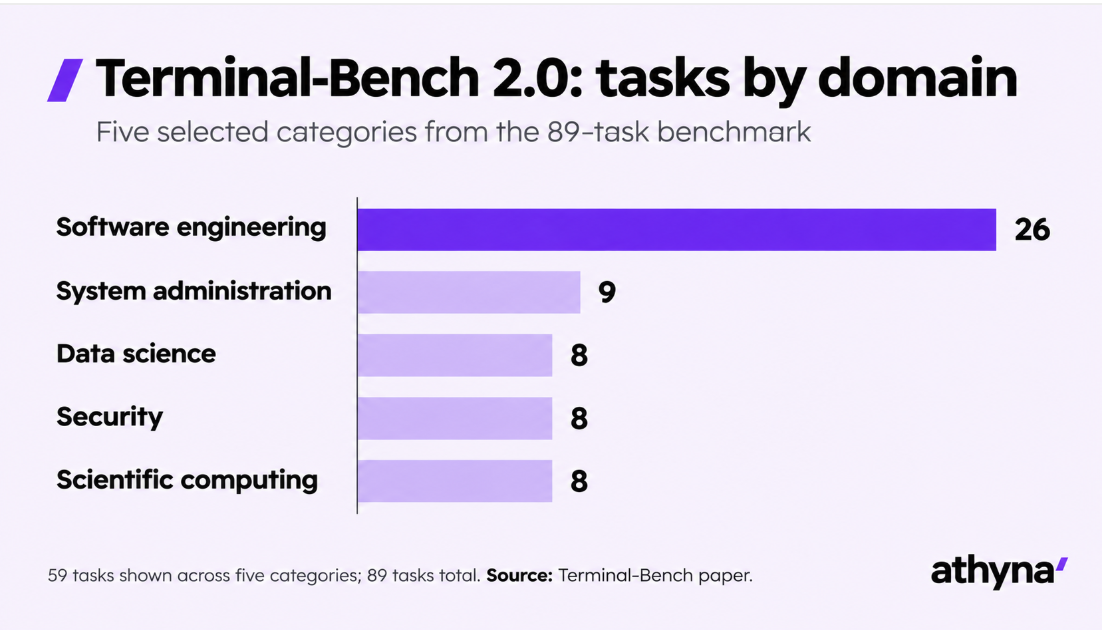
Agents faced challenges such as building Linux from source code or converting an old COBOL program into Python. GPT-5.2 running through Codex CLI achieved the highest score reported in the paper at 63%, leaving more than a third of the tasks unsolved by that setup.
Terminal-Bench 4.0 changed the types of tasks AI agents perform and the conditions used to evaluate them. Unlike Terminal-Bench 2.0, which focused heavily on software engineering, version 4.0 includes 66 tasks across seven technical domains. One example involves migrating a live e-commerce database without interrupting customer orders.
The shift began with Terminal-Bench 3.0, which introduced a new task set and separated agents from the automated tests used to grade their work. Released in August 2026, Terminal-Bench 4.0 refined that set.
Terminal-Bench now follows a continuous versioning system, with changes to grading requiring regraded results and changes to tasks or environments requiring new runs. Terminal-Bench 4.1, released in November 2026, retained the 66 tasks while updating grading and reproducibility.
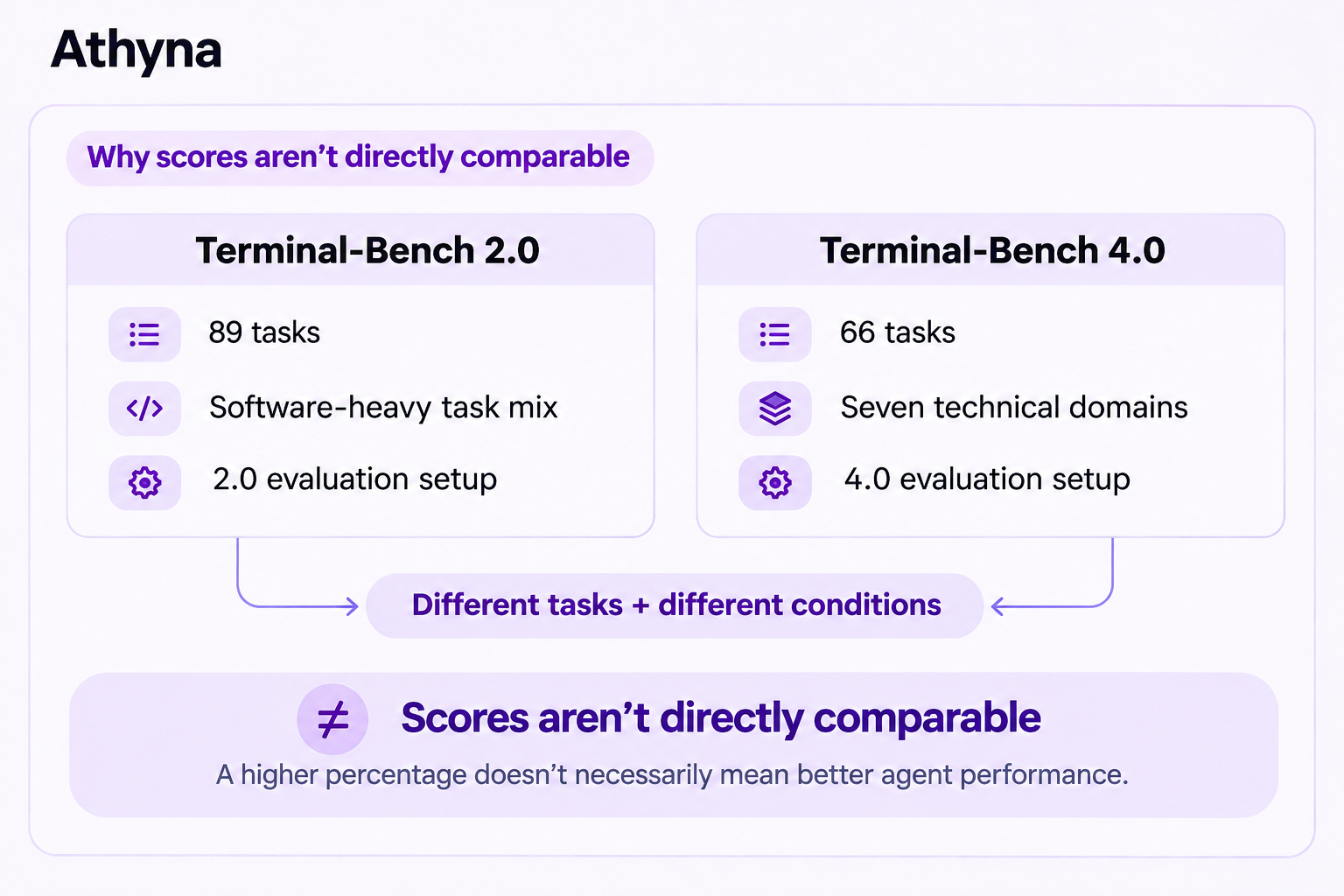
Terminal-Bench 2.0 and Terminal-Bench 4.0 differ in task count, technical domains, difficulty, and evaluation conditions. Both test AI agents working in a terminal, but their results reflect different benchmark setups.
The table includes Terminal-Bench 4.1 to show the latest updates to the 4.0 task set.
Terminal-Bench 2.0 and 4.0 scores aren't directly comparable because they measure success on different sets of problems. Neither score tells us how a model would perform on the other version's tasks.
The impact appears even in a smaller update. After maintainers revised 28 tasks in Terminal-Bench 2.1, Claude Opus 4.6 running through Claude Code scored 70.1%, up from 58.0% on version 2.0, according to the official release notes. The higher score reflects changes to the benchmark, without establishing an improvement in the model itself.
Claude Opus 5.5 running in Claude Code leads the official Terminal-Bench 4.0 leaderboard at 64.85% as of November 5, 2026. Results vary across leaderboards, depending on how the models are tested.
One difference is the agent harness (or scaffold), the software that lets a model interact with a terminal, run commands, and complete tasks. The official leaderboard uses different harnesses, including Claude Code and Codex, while Vals AI and Artificial Analysis use Mini-SWE-agent.
Scores reflect the percentage of tasks solved with one attempt per task, known as pass@1. Each provider averages repeated evaluations to reduce variation between runs.
Even the official leader isn't decisively ahead. Its 95% confidence interval runs from about 61.7% to 68.0% and overlaps with Sonnet 5.5's, which runs from about 58.9% to 64.8%. The overlap means the observed gap doesn't establish a clear performance advantage.
Anthropic's Opus 5.5 announcement reports 66.4% on its own setup, 1.55 percentage points above the public board. A score in a launch post reflects the conditions the lab chose.
Terminal-Bench 4.1 introduces changes to grading and evaluation consistency without replacing the 66 tasks from version 4.0. Released on November 3, 2026, the update adds isolated grading tests to reduce interference from agent activity, fixed software versions to make evaluations more consistent, and a separate 63-task dataset that runs without GPUs.
The update responds to grading problems identified by Epoch AI. According to the GitHub milestones, maintainers have closed reported issues and scheduled additional changes for version 5.0. Closed issues, however, do not independently establish that every grading defect has been resolved.
Terminal-Bench 4.0 shows that a benchmark is only as good as its expert-written tasks and verifiers. As the benchmark expanded into science, hardware, and media, assessing an agent's performance required expertise beyond software engineering.
A failed run also requires someone to examine the terminal session and determine whether the agent made a mistake or the instructions left out a requirement. Experience with the underlying systems helps reviewers make that distinction.
Athyna Intelligence matches AI labs with Terminal-Bench experts, including engineers with experience running Linux servers, Docker, and CI/CD pipelines. Its specialists support task authoring, verification test writing, and agent transcript review. Their work helps teams distinguish genuine agent failures from problems in the evaluation itself.

Terminal-Bench 4.0 is an open AI agent benchmark released in August 2026. It evaluates agents on 66 complex tasks across seven technical domains, including software engineering, science, security, and hardware. Agents work in computer terminals, and automated tests check whether they completed the required tasks.
Terminal-Bench 2.0 focused more heavily on software engineering and system administration, with 89 tasks. Terminal-Bench 4.0 expanded the scope to seven domains, introduced 66 entirely different tasks, and adopted continuous versioning with updated evaluation conditions.
No, you shouldn't compare Terminal-Bench 2.0 scores with Terminal-Bench 4.0 scores directly, because the two versions use different tasks, time limits, and verifiers. A higher number on 4.0 doesn't mean a model has improved. Even a small update moves scores. In May 2026, Claude Opus 4.6 in Claude Code rose from 58.0% to 70.1% after Terminal-Bench 2.1 fixed 28 tasks.
Model scores from Terminal-Bench 2.0 and 4.0 measure performance on different tasks under different evaluation conditions. A higher percentage on 4.0 does not establish improvement over 2.0. Comparisons between models are more meaningful within the same benchmark version and testing setup.
Claude Opus 5.5 running in Claude Code leads Terminal-Bench 4.0, at 64.85% on the official Terminal-Bench leaderboard as of November 5, 2026. Claude Sonnet 5.5 is second at 61.82%, and their confidence intervals overlap, so the gap isn't settled. On Artificial Analysis, which runs every model in Mini-SWE-agent, Kimi K3.1 Pro leads at 67.2%.
Terminal-Bench measures AI agents by assigning technical tasks in isolated computer environments and checking the results with automated tests called verifiers. Agents use a harness to interact with the terminal, while leaderboard scores report the percentage of tasks completed successfully.
Terminal-Bench 4.0 is a transparent benchmark with documented reliability problems. In September 2026, Epoch AI found scoring defects in 30 of its 66 tasks, including 19 false positives and 11 false negatives. Version 4.1, released on November 3, 2026, closed most of those issues, and the rest are scheduled for version 5.0, so check which version a score uses.