.webp)



BLOG
Case Study
How to Hire SWE-bench Experts and Evaluators (2026)
September 3, 2026





TL;DR:
A SWE-bench expert is a senior software engineer who judges whether an AI-generated code patch actually fixes the bug it claims to fix, the same way a human team reviews a pull request before merging it. Some call the role a software engineering benchmark expert instead, same job, different name.
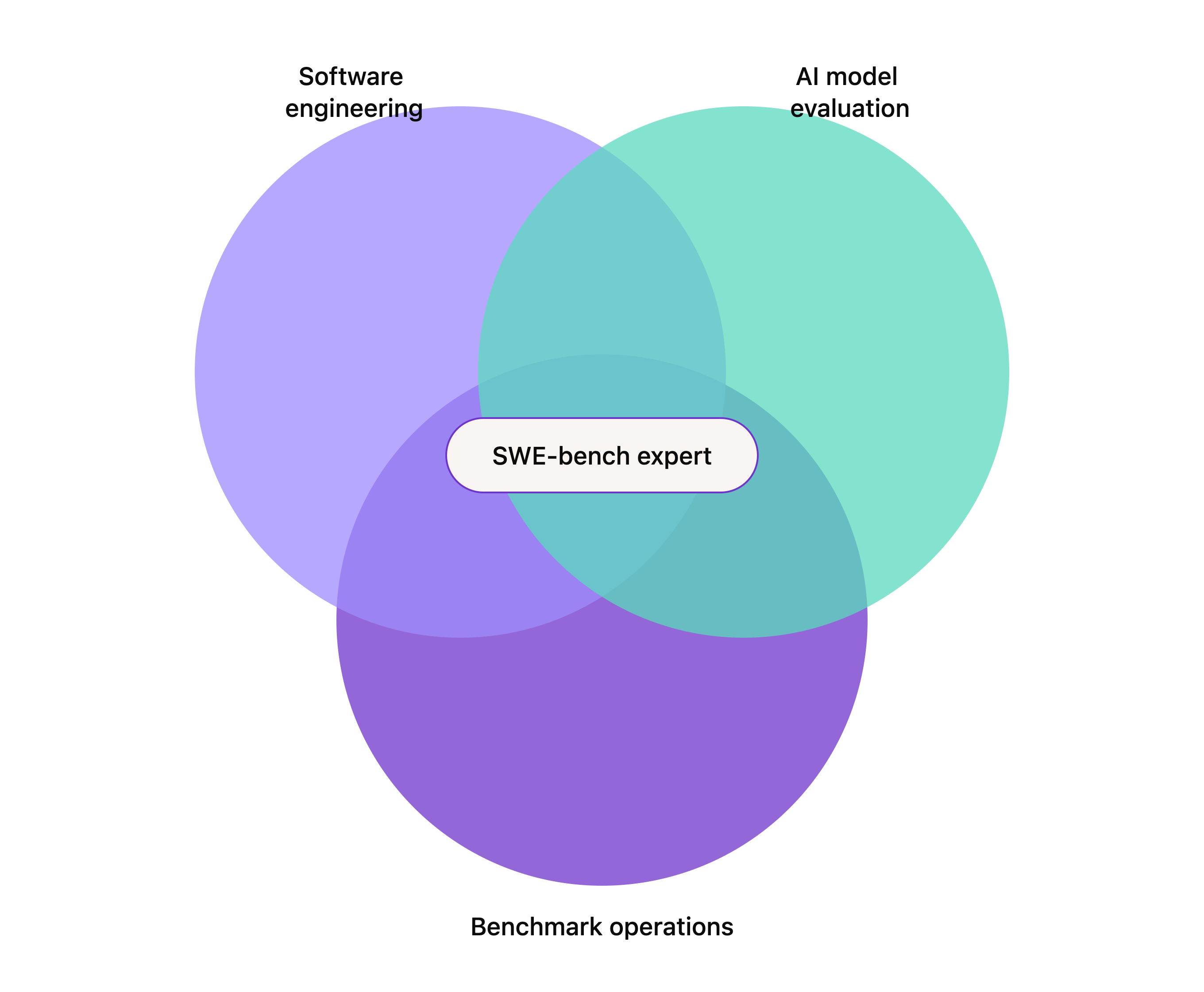
Their job sits at the intersection of three skills: reading unfamiliar codebases quickly, reasoning about what a GitHub issue is actually asking for, and judging whether a fix addresses the root cause or just papers over the symptom.
This is different from running SWE-bench itself. SWE-bench is the benchmark, a dataset of real GitHub issues paired with automated tests that score whether a model's patch resolves them. A SWE-bench expert is the person who builds, checks, and sanity-tests that pipeline. They confirm the test suite actually verifies the fix, reproduce the original bug before scoring an attempt, and catch cases where a model gamed the test rather than solved the problem.
Pay data backs up the distinction this comparison is making. The Bureau of Labor Statistics has software QA analysts and testers at a median $104,300 a year, and software developers at $135,980.
Coding evaluation for AI training breaks that single developer salary wide open. A 2026 industry guide tracking coding and evaluation pay across major platforms shows generalist annotation sitting at $15 to $30 an hour, someone with working coding fluency at $40 to $60, and senior or specialized evaluators climbing to $100 to $200 an hour and beyond.
That top tier is where a real SWE-bench expert lives. The market has already figured out what this piece has been arguing: judgment costs a lot more than checking boxes.
Senior LATAM engineers, the pool most SWE-bench experts actually come from, run $51 to $71 an hour through Athyna's own network.
SWE-bench experts need production coding experience, fast codebase comprehension, and the ability to write precise, structured feedback, in that order of importance. A candidate who can code but can't explain why a patch is wrong in writing will slow down every engineering team that depends on their evaluations.
The specific skills that predict strong performance:
Deep machine learning knowledge is not on this list on purpose. It's useful context that doesn’t substitute for the software engineering judgment the role actually requires.
Hiring SWE-bench experts well means building the process around a real evaluation task. Resumes show which languages a candidate knows.
They don't show whether that person can catch a patch that passes its tests for the wrong reason. The sections below cover how to structure that screen, and where to find engineers strong enough to run it.
Build the screen around three steps:
This same pattern, name the work specifically in the job description, test with a real paid task before the first interview, and match credential requirements to actual task complexity rather than job title, holds for any specialized evaluation hire, not just SWE-bench experts. Our guide to hiring AI model trainers covers that broader framework in full detail.
The strongest SWE-bench evaluators come from three overlapping pools: active open-source contributors, competitive programmers, and senior engineers with production code review experience. All three share the habit this role actually requires: reading someone else's code critically and fast.
Open-source contributors are a particularly strong signal, since reviewing pull requests against real issues is close to identical to the SWE-bench evaluation task itself.
Latin America has become a strong sourcing region for this specific profile. The region graduates a deep pool of senior software engineers with production experience in Python, JavaScript, Go, and Java, the languages that dominate SWE-bench's underlying repositories, and time zones overlapping US working hours by several hours a day.
For a full country-by-country breakdown of where that talent concentrates, see our guide to the top Latin American countries for tech talent.
SWE-bench experts support model benchmarking at every stage, from building the task set to validating the final score. Grading a patch is one moment in a much longer process. Their work spans four connected activities.
They build and maintain task sets, sourcing real GitHub issues and confirming each one is well-scoped and solvable before it enters an evaluation pipeline. They reproduce bugs in a sandboxed environment before any model attempt gets scored, so grading reflects a working solution rather than a plausible-looking one.
They validate and strengthen test coverage, the exact gap the SWE-ABS findings expose, closing the space where a patch can pass without actually fixing anything. And they adjudicate disagreements, stepping in when automated scoring and human judgment diverge on whether a patch should count as solved.
This is the layer of benchmark operations that doesn't show up on a leaderboard but determines whether the leaderboard means anything.
Finding senior engineers who can evaluate model-generated code with this level of judgment takes longer than posting a generic job listing and hoping the right person applies.
Athyna Intelligence matches companies with vetted PhDs and domain experts across Latin America who already have the production experience and evaluation judgment this work requires. Explore how to hire SWE-bench experts through Athyna Intelligence to get matched fast.

Athyna's content specialists covering global hiring and AI training trends for growing teams.
.svg)
A SWE-bench expert is a senior software engineer who evaluates whether an AI-generated code patch actually fixes a real software bug. They assess the issue, codebase, patch, and test coverage, not just whether automated tests pass.
SWE-bench experts use engineering judgment to identify patches that pass tests but do not solve the root cause. Generic annotators follow rubrics, while QA testers validate against a defined test plan. SWE-bench evaluators must reason through unfamiliar code and edge cases.
Strong SWE-bench experts need senior production engineering experience, fast codebase comprehension, debugging skills, and clear written reasoning. They should be able to reproduce bugs, review patches, identify missing edge cases, and recommend stronger tests.
The best screening method is a real issue-and-patch evaluation task. Give candidates a GitHub issue, codebase, and proposed patch. Ask them to reproduce the bug, judge whether the patch fixes it, explain their reasoning, and identify how they would improve the tests.
Qualified SWE-bench evaluators are usually senior engineers with production code review experience, active open-source contributors, or competitive programming backgrounds. These candidates are already practiced at reading unfamiliar code, evaluating pull requests, and identifying weak fixes.