
Preferences

Privacy is important to us, so you have the option of disabling certain types of storage that may not be necessary for the basic functioning of the website. Blocking categories may impact your experience on the website. More information

Accept all cookies

These items are required to enable basic website functionality.

Always active

These items are used to deliver advertising that is more relevant to you and your interests.

These items allow the website to remember choices you make (such as your user name, language, or the region you are in) and provide enhanced, more personal features.

These items help the website operator understand how its website performs, how visitors interact with the site, and whether there may be technical issues.

Thank you! Your submission has been received!
Oops! Something went wrong while submitting the form.
Empty pale yellow rectangle with rounded corners and a thin purple border.
BLOG
Case Study

What Are the Top Hiring Trends in 2026?

February 2, 2026

VectorVector

Table of Content

Industry
Stage
Country

Hiring in 2026 doesn't look like it did two years ago.

Economic pressure, AI acceleration, and different scenarios have changed how companies build their teams. The playbook that worked for years won’t work in 2026. Not because those tactics were bad, but because everything underneath them shifted.

Hiring trends changed and can vary by company size. This guide breaks down the structural shifts affecting all three, then shows you exactly how to adjust your strategy based on where you sit. Check it out.

Why Hiring Looks Different in 2026

Here's what happened. Companies hit a perfect storm where budgets tightened, AI changed how recruiting works, and talent got harder to find in traditional markets. These three things colliding at once forced a fundamental rethink of how hiring happens.

  • Economic pressure made cost efficiency non-negotiable. Rising US salary benchmarks have pushed companies to evaluate total compensation against what talents are actually delivering, particularly for technical roles. Businesses are paying more without getting more value.
  • AI fundamentally changed recruitment workflows. Tasks that used to take days now happen in hours, but still, companies are throwing AI at everything. and not using it strategically.
  • Talent shortages pushed companies to look globally. When you can't find the AI engineer you need in the US—or when you find them but they cost $200K—you start looking at other markets. Companies discovered strong talent in places like Latin America, where costs are 40-60% lower.

You can check the salary report here:
Salary report USA vs Athyna 2026

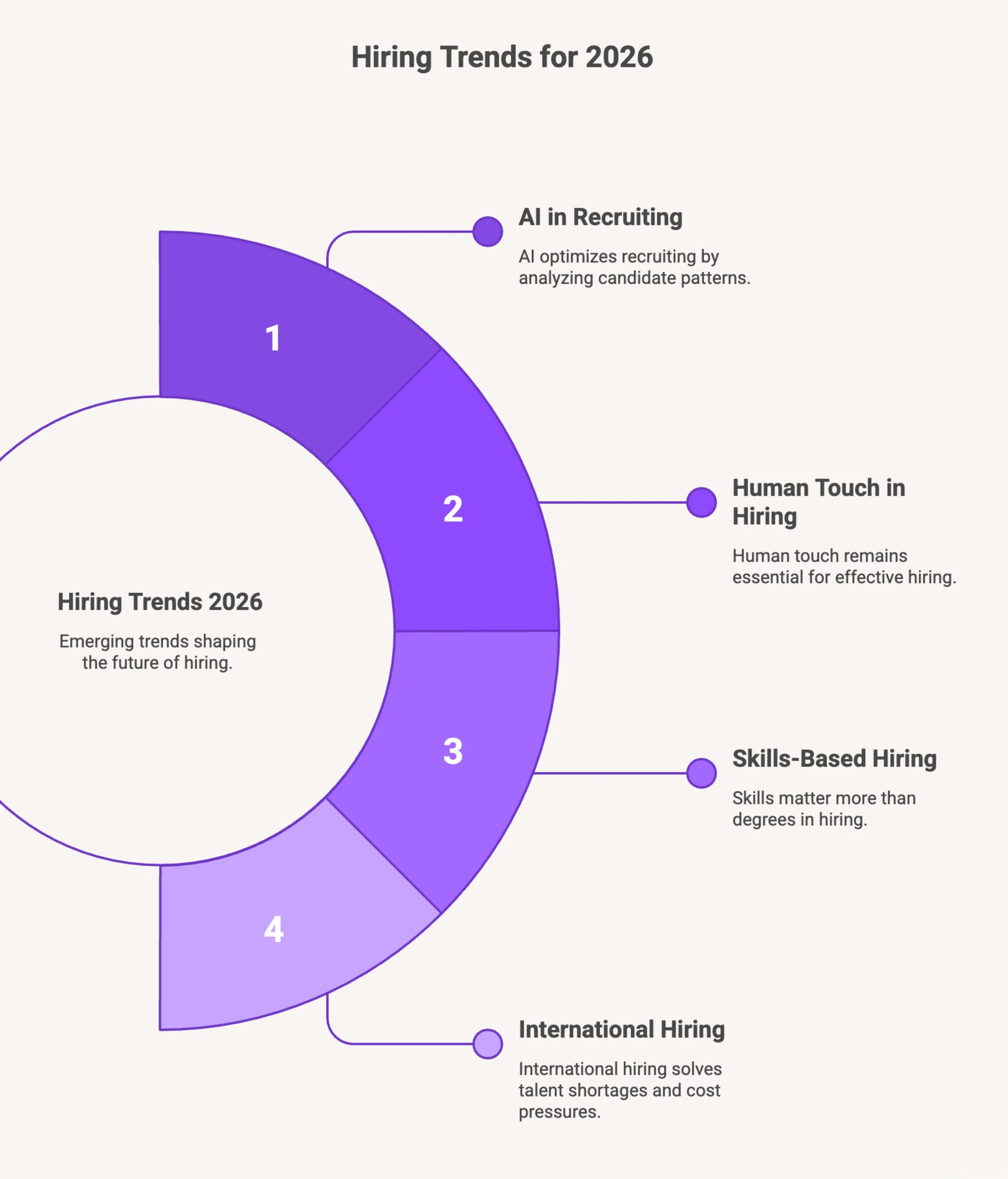
Hiring Trends 2026

Understanding how these hiring trends interact helps you see which moves make sense for your specific situation. And here they are:

AI Is Changing How Companies Hire

AI has become one of the main tools to optimize recruiting. These systems don't just find candidates faster; they find better matches by analyzing patterns human recruiters might miss.

Faster candidate shortlists mean recruiting teams spend less time on initial screening and more time on evaluation conversations that actually matter. Skills-based matching algorithms predict candidate success by analyzing work samples and assessment results rather than relying on proxies like previous company names.

Human Touch Is Unnegociable

If AI made recruiting faster, it also created a new problem. Companies that automated too much lost the human element in their hiring process. The result? Processes that feel impersonal and decisions that miss the mark on who's actually the right fit.

You can optimize for speed and still make bad hires. An algorithm can tell you someone has the right keywords on their resume, but it can't tell you if they'll mesh with your team or handle ambiguity well. It can't catch the red flags that come up in conversation or identify the intangibles that make someone successful in your specific environment.

What's still essential even with AI in the mix:

  • Real conversations with actual people during the evaluation process, not just automated emails
  • Feedback on why they did or didn't move forward, even if it's brief
  • Transparency about process and timeline so they're not left guessing where they stand
  • Human judgment on cultural fit, because no algorithm can replace the "do I want to work with this person" conversation

Skills Matter More Than Degrees

Skills-based hiring has changed how companies evaluate candidates. Technical tests matter more than resumes now. Companies care about what you can actually do, not where you went to school or which logos are on your LinkedIn.

How evaluation changed:

  • Technical assessments come first, resumes second. Companies want to see what you can actually do before they care about your educational pedigree.
  • Portfolio work trumps job titles. A strong profile or design portfolio shows capability in ways a resume never will.
  • Recent certifications beat old degrees. An AWS certification from last quarter tells you more about someone's current knowledge than a CS degree from 2019.

International Hiring Has Become the Solution

Global hiring is a hiring trend mainly because it solves multiple problems at once: talent shortages, cost pressure, and the need for teams that can operate across time zones.

US companies aren't treating international hiring as an experiment anymore. It's just how teams get built now. The growth is particularly strong in Latin America, where companies find talent that combines technical skills with cultural alignment to US business practices.

Embedded global team models have replaced freelance-only approaches. Companies want full-time team members who share their mission, not contractors who juggle multiple clients. This shift toward permanent global teams has changed how companies think about geographic diversity.

Basically:
  • Latin American hiring has grown because companies figured out the advantages: cultural fit with US business practices and time zones that actually overlap.
  • Full-time global teams have replaced the freelancer model. Companies want people who are all-in on the mission, not contractors splitting attention across five clients.
  • The administrative barriers are gone. Platforms like Athyna now handle payroll, benefits, and legal compliance across borders.
  • Headcount freezes get solved by building international teams that don't count against US headcount caps.
Hiring trends

Hiring Trends for Startups & SMBs in 2026

When you're building lean teams, every hire has to deliver immediate impact. There's no room for speculation.

What defines startup hiring in 2026:

  • Leaner teams with higher impact per hire: you need people who figure things out independently and level up quickly. Look for candidates already navigated the problems you're about to hit.
  • Shorter decision cycles give you a competitive advantage. When you take three weeks to decide, strong candidates have already accepted offers elsewhere. Speed is your edge against competitors.
  • Greater openness to remote hiring. If you need specific skills at costs that make sense for your runway, exploring this new hiring trend will change your business's strategy.
  • Focus on predictable outcomes because you can't afford bad hires. You need people who integrate quickly and start contributing within their first month.
  • Build automations process for your hiring. Turn successful hires into a template you can replicate instead of reinventing the approach each time.

The hiring decisions you make now will shape your company's trajectory for the next 18 months. Getting those decisions right means being strategic about where you source talent, realistic about what you can afford, and creative about how you structure offers.

Hiring Trends for Enterprises in 2026

When you're dealing with headcount caps, lengthy approval processes, and compliance requirements that smaller companies sidestep. You need smart solutions.

Key enterprise hiring trends:

  • Hiring continues despite headcount caps through creative workarounds like using international teams outside US headcount limits, or restructuring roles to fit the budget.
  • Alternative hiring models solve the headcount freeze problem.
  • Specialized talent shortages will keep increasing. These roles require very competitive compensation in the US, pushing global talent pools as the best solution.
  • Global hiring requires structured compliance that legal, finance, and HR teams must all approve. Platforms like Athyna managing compliance have become an essential partner.
  • Budget optimization tied to OKRs means every hire must connect to measurable outcomes. You're demonstrating how each role contributes to specific targets.

How to Adjust Your Hiring Strategy in 2026

Understanding what's changed matters less than knowing how to respond to it. Check some tricks that might help you.

  • Run the actual cost-per-hire numbers because most companies are optimizing for the wrong metric. You're tracking salary, but salary is only one line item. Factor in recruiter hours, how many candidates you need to screen to get one hire, how long roles stay open, and the opportunity cost of unfilled positions.
  • Get strategic about where AI adds value and where it doesn't. Use it for initial resume screening and candidate sourcing—the volume of work that bogs down recruiters. Don't use it for cultural fit evaluation or final decisions. Set up your process so AI handles the first filter, then humans take over for everything that requires judgment. Most teams get this backwards and wonder why their quality dropped.
  • Rebuild candidate experience around human touchpoints. If you're using AI for screening, make sure actual people are communicating outcomes and next steps. Candidates need to hear from humans about where they stand, even if the news is "you're not moving forward."
  • Implement skills assessments as your primary filter. Stop leading with resume screening and credentials. Lead with technical tests, portfolio reviews, or work samples that show what someone can actually do.
  • Scale international hiring as a core strategy. You get access to specialized talent, reduce hiring costs by 40-60% without quality trade-offs, and build diverse teams. Pick your target regions, establish compensation bands, and start building teams there the same way you'd build them domestically.

Hire Globally with Athyna

Athyna makes global hiring simple. We match you with vetted professionals from Latin America and globally in days. And our team handles the complexity—payroll, compliance, benefits—while you focus on growing your business.

You get world-class talent at costs that actually make sense, with the confidence that comes from working with professionals who've already been vetted for skills and cultural fit.

Whether you're a startup extending runway or an enterprise working around headcount caps, the math is straightforward: hire great people at sustainable costs, move faster than competitors still relying on traditional hiring, and build teams that scale with your business.

Ready to see what's possible? Let's talk about how global hiring fits your specific situation.

Role
Typical US Salary
With Athyna
Savings
Role
Junior HITL QA Analyst
QA Analyst
Python Developer
{Role Name}
Totals
Typical US salary
$128k
$86k
$124k
{Amount}
{Amount}
With Athyna
$45k
Saved 65%
$34k
Saved 65%
$42k
Saved 65%
$42k
Saved 65%
$42k
Saved 65%
Fernanda Silva

Digital Strategist at Athyna, aka the SEO girl.

Frequently asked questions

What are the biggest hiring trends in 2026?

The biggest hiring trends in 2026 are AI-powered recruitment workflows that speed up candidate screening, cost efficiency driving every hiring decision, and international hiring becoming standard practice rather than experimental. Companies are focusing on skills-based assessments over credentials and building embedded global teams for both cost savings and access to specialized talent.

Why is international hiring growing so fast?

International hiring has grown because it solves multiple problems, such as accessing specialized skills that are scarce in the US market, reducing hiring costs by 40-60%, and building diverse teams.

How is AI changing recruitment in 2026?

AI has moved from experimental to essential in recruitment. Automated sourcing scans millions of candidate profiles to find matches based on skills rather than keywords, resume screening happens in hours instead of days, and predictive algorithms forecast job performance using work samples and assessment data.

More articles like this

Talk to us

Let's match you with the right AI training experts

Fill this form and we’ll get in touch with you 🚀
Please enter a valid business email
Thank you! Your submission has been received!
Oops! Something went wrong while submitting the form.