


BLOG
Case Study
How to Build a Hiring Process: Step-by-Step Guide
February 1, 2026





Hiring should be straightforward. But for some, the hiring process feels slow, unclear, and harder than it should be.
The problem isn't that hiring is complicated. Most companies just don't have a clear, repeatable process. Without one, every hire turns into an improvised disorder instead of a strategic decision.
This guide covers building a hiring process that works. You'll see the core steps, realistic timelines, where things break down, and how remote hiring changes things. And if you’re wondering, all these steps apply whether you're hiring your fifth person or your five hundredth, remote or not. Check it out.
The hiring process is how companies identify, evaluate, and bring in new people. It starts when you realize you need someone and ends when they're onboarded and contributing.
This matters more than HR paperwork might suggest. Your hiring process affects how fast you scale, how well teams deliver, and whether you're building the right capabilities. Strong processes help you decide better and faster. Broken ones waste time, money, and momentum.
People mix up the hiring process and the recruitment process constantly, but they mean different things.
Recruitment is attracting and sourcing candidates. Posting jobs, reaching out to prospects, building pipelines.
Hiring is the whole thing. Defining roles, sourcing people, screening and interviewing, deciding, making offers, and onboarding.
Why does this matter? Most hiring problems happen after sourcing. It happens when you get 50 applications, but can't agree on evaluation criteria. Or you find great candidates, but take three weeks to schedule interviews. Understanding where recruitment ends, and the rest of hiring begins, helps you fix the actual bottlenecks.
Because poor hiring processes are expensive, it costs way more than most people realize. The obvious cost is that the empty role results in lost revenue, delayed projects, and exhausted teams covering extra work.
But the hidden costs run deeper. Your employer brand is affected when candidates have poor experiences, hiring managers get frustrated with drawn-out processes, and recruiters spend weeks on roles that never close. Top candidates accept other offers while your team is "still deciding.” This all costs you time and long-term revenue.
Poor hiring also damages team performance and engagement. When roles stay open for months, your best people start getting overwhelmed. And when bad hires slip through, everyone else deals with misaligned work, team issues, and eventually, more turnover.
Speed matters, and so does quality. You can't hire fast and cross your fingers. You need a process where both work together through clear role definitions, aligned stakeholders, consistent criteria, and actual decisions that get made. See more on how to structure your hiring process.
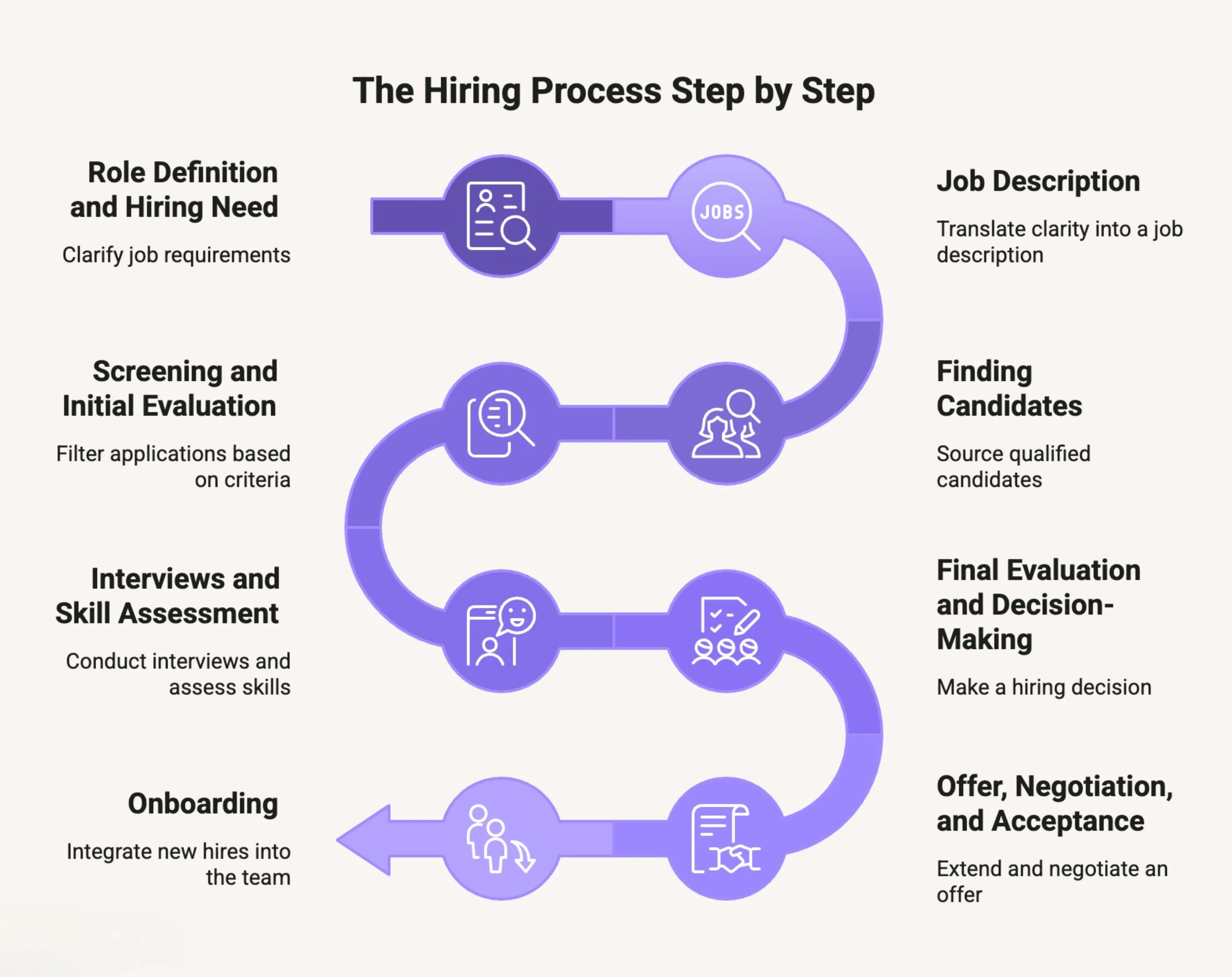
Let's walk through what hiring actually looks like, from realizing you need someone to having them deliver results.
The hiring process starts with getting clear on what you're actually hiring for, before posting anything or talking to candidates. Job titles alone won't guide effective hiring. You need clarity on what this person will actually accomplish and deliver.
Start with this question: What problem does this person solve?
Replacing someone who left requires different considerations than filling a skill gap on your existing team. Scaling capacity for growth introduces yet another set of priorities.
Define the role properly. Here are some questions that can guide you:
Once you're clear on the role, translate that clarity into a job description. A well-written job description brings in candidates who actually fit what you need.
The key is focusing on outcomes rather than generic responsibilities. When you write “manage projects” in a job description, candidates have no idea what that means in your context. Compare that to something specific: own product launches from planning through execution, coordinating across engineering, design, and marketing to ship on time. Now candidates know exactly what they'll do, who they'll work with, and what success looks like. This specificity helps qualified people self-select in and saves you from reviewing applications from poor fits.
Beyond the role itself, describe how your team operates. If you're remote-first and async-heavy, state that upfront. If you move fast and expect people to work independently, make it obvious. These details help candidates assess whether they'll thrive in your environment, not just whether they can do the tasks.
Your job description serves dual purposes: filtering candidates and making a first impression. Get it right, and you attract people who are genuinely suited for the role.
The hiring process moves to sourcing once you've defined the role and written your job description. Sourcing is how you get qualified candidates into your pipeline.
Where and how you source directly impacts who applies. Different sourcing channels reach different talent pools, and each method has distinct advantages depending on what you're hiring for. Here are some examples:
The challenge in competitive markets is that everyone's looking in the same pool. If you're hiring software engineers, product marketers, or senior operators, you're competing with hundreds of other companies for the same people.
This is where clarity pays off. Candidates with options choose companies that know what they want, move quickly, and communicate clearly. If your hiring process is slow and opaque, top candidates won't wait around.
Applications start coming in. Now someone has to sort through them and decide who moves forward.
At this stage, focus on the basics. Does this person have relevant experience in similar roles? Do their skills match what you actually need? Are there any mismatches between what they're looking for and what you're offering?
Look for alignment on key factors. Do they have experience with the tools, technologies, or methodologies you use? Does their career trajectory show growth in areas relevant to this role? Are their expectations around work style, compensation, and growth opportunities realistic for what you can offer?
The screening mistake most companies make is going to extremes. Too rigid, and you filter out unconventional candidates who could excel in the role. Too loose, and you waste hours interviewing people who were never realistic fits. Effective screening requires criteria tied directly back to your role definition from step one.
Most companies structure the hiring process with multiple interview formats, each serving a specific purpose. Common formats include:
Structure matters less than consistency across candidates. When you ask different questions to each person, a fair comparison becomes impossible. When interviewers evaluate different qualities without shared criteria, you end up with conflicting opinions and stalled decisions. Everyone has a different take, but nobody can articulate why.
Keep the process efficient and respectful of candidates' time. Three interview rounds are reasonable for most roles. Seven rounds with repetitive conversations signal that your team struggles with decision-making, and top candidates won't wait around.
Make your assessments reflect real work. If you're hiring a content marketer, have them analyze and improve one of your actual campaigns. For a developer role, present a problem similar to what they'd solve in their first month. Generic tests and abstract puzzles don't predict performance nearly as well as realistic work samples.
The hiring process reaches a critical point after interviews wrap. Someone needs to make a decision, and this stage works best with a clear structure. Check some best practices:
You've picked someone. Now it’s time to make an offer.
A complete offer covers compensation (salary, equity, bonuses), benefits, work setup (remote, hybrid, office), and start date. Be specific about all of it as much as you can to avoid creating confusion and give candidates reasons to keep exploring other options.
Negotiation is also part of the process. Candidates will counter on salary, equity, title, or work flexibility. Know your boundaries before you extend the offers to ensure you respond quickly instead of going back and forth for weeks.
The time between offer and acceptance matters more than most companies realize. Candidates weighing multiple options need a few days to decide, but extended silence makes you look indecisive. Aim for clarity within 3-5 business days for most roles.
Once you have the perfect candidate, keep the momentum going. The gap between acceptance and their start date is when competing offers show up and second thoughts kick in. Stay in touch, share onboarding details, introduce them to a few team members, and help them feel connected before day one.
Onboarding isn't separate from the hiring process. It's the final step that shows whether your process actually worked.
Good onboarding helps new people contribute quickly, understand team dynamics, and feel confident. Bad onboarding leaves them confused, disconnected, and wondering if they made a mistake.
Some best practices are to cover the basics:
Most companies with the lowest regrettable turnover do two things right. They hire well, and they onboard well. Hiring ends when someone performs, not when they sign a piece of paper.
How long does hiring take? Depends on too many factors to give a simple answer.
Industry averages run 30-45 days from posting to accepted offer. Some companies move faster. Startups and small teams can make quick decisions. Others drag on for months, especially bigger organizations with several approval layers.
Most hiring delays happen at predictable bottlenecks.
Role definition and approval take weeks when stakeholders disagree, or budgets get stuck. Sourcing qualified people slows down in competitive markets or for niche roles. Interview scheduling becomes calendar Tetris with multiple stakeholders involved. Decision-making stalls when nobody wants to commit, or feedback stays scattered.
Clear processes and good tools cut time-to-hire significantly. Well-defined roles, consistent criteria, and aligned decision-makers let you move from first interview to offer in under two weeks.
And if you’re wondering if there’s any way to move faster without losing quality. The answer is yes. Here at Athyna, we match companies with pre-vetted global talent and can present qualified candidates within 4 days. Our process works differently because we maintain a network of vetted professionals, handle the screening and initial evaluation, and only connect you with candidates who match your specific requirements.
Even well-designed processes break down. Here are the usual culprits and what actually works to fix them:
Remote hiring changes how the hiring process works. You're evaluating different skills, using different formats, and looking for different qualities in candidates.
Three reasons drive remote hiring. Access to skills that don't exist locally—specialized expertise, language capabilities, or niche experience your market can't provide. Cost efficiency in regions where qualified talent costs less. Building distributed teams that span time zones and extend when work gets done.
The hiring process for remote roles prioritizes different capabilities than office-based traditional hiring.
Communication becomes more critical. Remote workers can't walk over to ask questions or clarify things quickly. They need to write clearly, communicate proactively, and keep teams informed without constant nudging. In interviews, pay attention to how candidates explain complex ideas and whether they ask clarifying questions.
Async collaboration skills matter more. When your team has multiple time zones, you can't assume everyone's online at once. Strong remote candidates document their work, provide context without being asked, and move projects forward independently. Test this in your hiring process with written exercises or take-home assignments.
Self-direction becomes essential. Remote work requires people who structure their own time, solve problems without immediate support, and deliver results with less oversight. Behavioral questions should dig into how candidates have handled ambiguous situations or worked with minimal direction.
Remote interviews can change what you evaluate. You lose some ability to read energy and presence through a screen, so structure interviews more carefully. Ask specific questions about remote work experience.
You can also build assessments that test remote-relevant skills. Beyond technical capability, evaluate how people communicate in writing, manage their time, and handle working independently. A take-home project often reveals more about remote work fit than a live coding session.
We match world-class global talent to ambitious teams with AI precision, at lightning speed. Instead of spending months on sourcing, screening, and evaluating, we handle that and connect you with vetted professionals ready to contribute.
We learn what you need (role, skills, work style, team dynamics) and match you with pre-vetted candidates from our global network in days.
Faster hiring, better matches, easier team scaling. Whether you're building a fully global team or adding specialized global talent your local market doesn't offer, we help you go from hiring need to productive team member in days instead of months.
.webp)
Digital Strategist at Athyna, aka the SEO girl.
.svg)
The hiring process is how companies identify, evaluate, and bring in new talent. It includes defining roles, sourcing candidates, screening and interviewing, making decisions, extending offers, and onboarding.
Remote hiring emphasizes communication skills, async collaboration, and cultural adaptability. Processes shift to evaluation criteria that account for independent work and virtual collaboration.
The average is 30-45 days from posting to accepted offer. Timelines vary based on role complexity, company size, and process efficiency. At Athyna, we can present qualified candidates within 4 days.
Defining the role and need, writing a job description, sourcing candidates, screening and initial evaluation, interviews and skill assessments, final evaluation and decision, offer and negotiation, and onboarding.
Good processes have clear ownership at each stage, predictable timelines, minimal bottlenecks, and consistent candidate experience. They balance speed with quality, treat people respectfully, and adapt to different roles while maintaining structure.
Large companies have complex approval layers, multiple stakeholders with competing priorities, and rigid processes that slow decisions. Bureaucracy, risk aversion, and unclear ownership at each stage all contribute to longer timelines.