



BLOG
Case Study
Benefits of Hiring in Latin America: A Complete Guide for U.S. Companies
April 22, 2026





Latin America has become a core part of how US companies build engineering, marketing, operations, and finance teams. The region offers something most international hiring markets don't: real-time collaboration hours, deep senior talent, and meaningful cost efficiency, all in the same package.
This guide covers the strategic advantages, the real challenges, and the mistakes that derail companies new to LATAM hiring. If you've already decided to hire and want the step-by-step process, start with our guide to hiring LATAM professionals.
Key Takeaways:
US hiring markets have gotten harder and more expensive at the same time. A senior engineering role that should take six weeks to fill now routinely takes four months, and domestic salary expectations have climbed well past what most growing teams can sustain at scale.
Latin America solves three problems simultaneously that other regions don't:
Teams already distributed across San Francisco, Austin, and New York find that adding Mexico City or Bogotá changes almost nothing about how they operate day-to-day.
Cost matters, but it's not the only reason companies keep coming back. The strategic advantages compound over time in ways that pure cost-cutting doesn't.
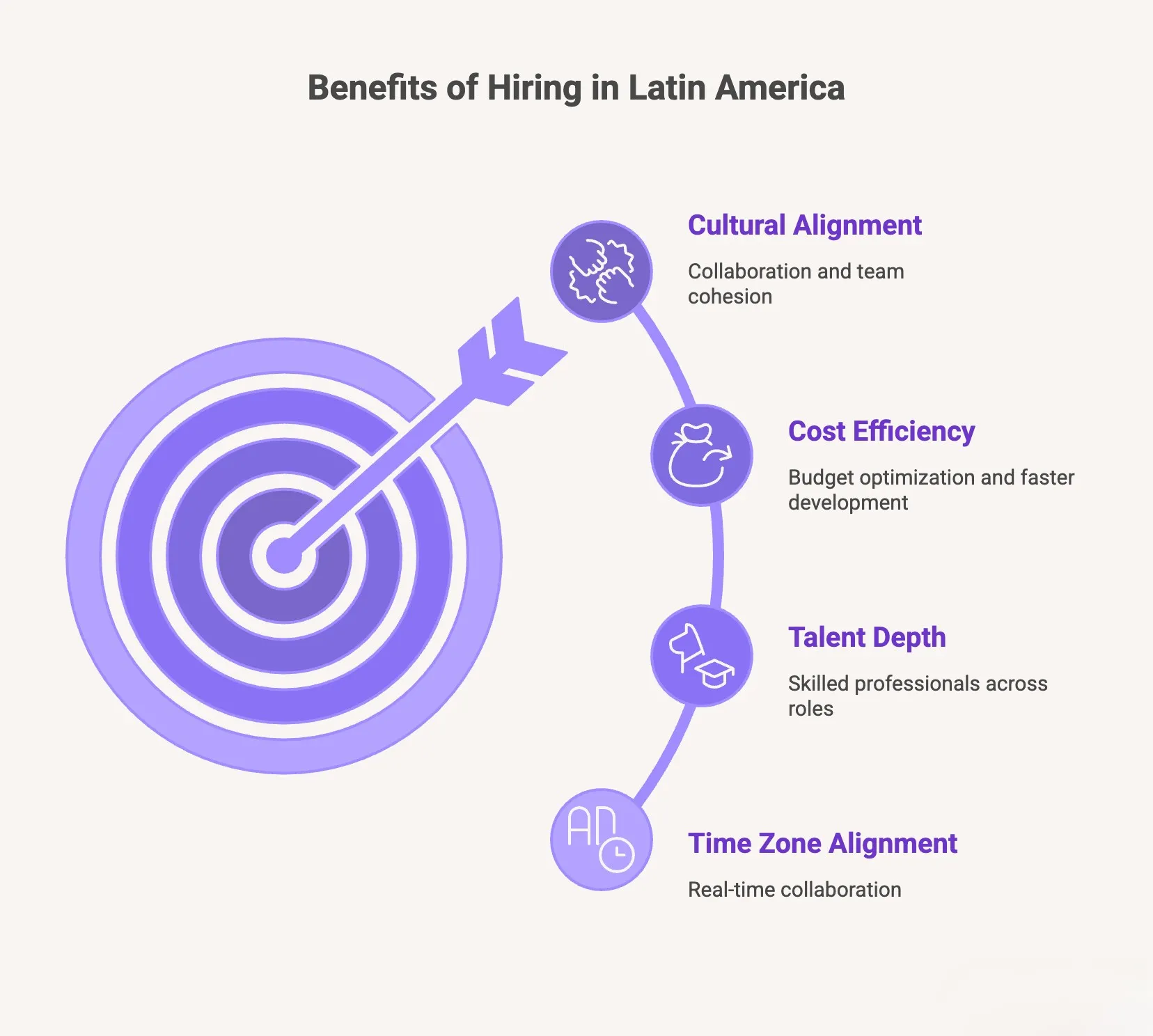
Colombia operates at UTC-5, the same offset as US Eastern Standard Time. Mexico City runs on Central Time. Brazil and Argentina (UTC-3) still overlap 6-7 hours with East Coast business hours. That means morning standups, real-time Slack threads, same-day code reviews, and afternoon syncs, without anyone working unusual hours.
Compare that to Southeast Asia, where a 10-12 hour gap makes async-only work a structural necessity. LATAM is the only major remote hiring region where synchronous collaboration is the default.
Latin America is home to over 2 million software developers, with major talent pools in Brazil, Mexico, Colombia, and Argentina. This isn't a junior-heavy market. Senior engineers with 8-12 years of experience building complex systems are available across the region. Many have worked at regional offices of companies like Google, Microsoft, and Amazon before moving to distributed roles.
The depth extends beyond engineering. You can find experienced product managers, UX designers, data analysts, finance operations specialists, and marketing professionals throughout the region. LATAM hiring isn't a tech-only play.
The Bureau of Labor Statistics puts the median US software developer salary at $130,160. A comparable mid-senior engineer in Mexico, Brazil, or Colombia typically earns $40,000-$55,000. That's a 55-65% cost difference before factoring in benefits, payroll taxes, and recruiting overhead.
The math changes at the team scale. The budget for three US engineers funds five LATAM engineers. That's faster development cycles, capacity for simultaneous workstreams, and bandwidth for projects that keep getting pushed. For more current benchmarks by country and role, Athyna's 2026 LATAM Salary Report is the most up-to-date reference we publish.
Latin American work culture emphasises collaboration, relationship-building, and team cohesion, which fits naturally with how most US distributed teams already operate. The communication style tends toward clarity and directness without the adversarial dynamic some teams encounter in other markets. Most US hiring managers report that LATAM hires integrate faster and with less friction than comparable hires from more culturally distant regions.
Every hiring market has friction. LATAM is no exception. The difference is whether you understand the challenges before they become problems.
Employment law varies significantly by country. Brazil's labor code differs from Mexico's, which differs from Argentina's. The biggest practical risk for US companies is misclassification: hiring someone as an independent contractor while treating them like a full-time employee, setting their hours, providing equipment, directing daily work.
Most LATAM countries apply a substance-over-form standard. If the working relationship looks like employment, authorities will treat it as employment, regardless of what the contract says. Consequences include retroactive back pay, statutory benefits, and fines. Per ADP, the 13th-month bonus is a legal requirement across most of the region, including Argentina, Brazil, Colombia, Costa Rica, Mexico, and Peru. That's not optional compensation; it's a statutory obligation most teams new to LATAM don't budget for.
The solution is straightforward: use an Employer of Record (EOR) or a platform like Athyna that handles compliance end-to-end. You direct the work; the infrastructure handles the legal side.
Check more how to hire international employees legally.
US hiring teams understand which companies have strong engineering cultures and which universities produce reliable graduates. That knowledge doesn't transfer to LATAM automatically. A resume from a São Paulo fintech and a resume from a Bogotá bootcamp require very different evaluation lenses.
The fix is either building that local knowledge in-house (slow and expensive) or working with a partner that already has it. Good vetting in LATAM covers technical skills, English proficiency assessed live rather than self-reported, remote work readiness, and cultural fit with how your team operates.
English proficiency varies by candidate, not by country. The professionals actively targeting US remote roles generally have strong written and verbal English. The mistake is assuming this is true of all candidates rather than testing it early.
Structured onboarding is the other half of the equation. Most communication problems in distributed teams don't come from language barriers. They come from unclear expectations. New LATAM hires need explicit documentation of how your team works, regular early check-ins, and a clear point of contact for questions. The first 30 days set the pattern for the next two years.
English proficiency varies by candidate. Some LATAM professionals communicate at native-level fluency, while others need more time in verbal discussions but handle written work without issues.
Most communication problems don't come from cultural differences, as everyone assumes, but they come from unclear expectations and assumptions that everyone interprets requirements the same way.
That is why language assessment has to be part of your vetting process to make sure the communication matches your style.
The bigger risk here is assuming new LATAM hires will absorb how your team works without actually telling them the expectations. Structured onboarding fixes this. Pair new hires with experienced team members who explicitly teach them how your team operates, document your actual workflows, communication expectations, and decision-making processes. Schedule regular check-ins during the first few weeks to surface confusion before it becomes embedded problems.
Companies repeat the same mistakes when hiring in Latin America. Knowing what goes wrong helps you avoid it.
The hiring process for LATAM talent doesn't fundamentally change. You still need to define the role, vet candidates, interview, and onboard. What changes is the employment structure you use to make it legal and compliant.
You have two main options for hiring in Latin America:
Both options solve the same core problem: hiring internationally without setting up legal entities in multiple countries.
For the full step-by-step process, including how to choose between hiring models, benchmark compensation, screen candidates, and structure onboarding, see our complete LATAM hiring guide.
Employment law complexity varies by country. Here's what you need to know at a high level before diving deeper.
Payroll, taxes, and benefits: Employers in LATAM typically handle income tax withholding, social security contributions, health insurance contributions, and sometimes pension fund contributions. The specific requirements and rates vary by country. Brazil has some of the highest employer contribution rates in the region. Mexico's are lower but still substantial.
IP protection and contracts: Employment contracts need to include intellectual property assignment clauses that make clear the company owns work product created during employment. Different countries have different default rules about IP ownership, so explicit contracts matter.
Most companies handle this through Employer of Record services or by working with platforms that manage compliance as part of their offering. Trying to become an expert in Colombian labor law yourself usually doesn't make sense unless you're planning to open a formal office there.
Athyna matches ambitious teams with vetted global talent from Latin America using AI precision. We handle sourcing, vetting, compliance, and employment infrastructure so you can focus on the work itself. Most roles reach a shortlist in days, not weeks.
Contact our team to get started
.webp)
Digital Strategist at Athyna, aka the SEO girl.
.svg)
Yes. US companies can hire in Latin America through an Employer of Record, a talent platform, or by establishing a local legal entity. Simply paying someone as a contractor works initially but creates misclassification risk at scale, especially for long-term, full-time arrangements.
Software engineering roles work particularly well, but the depth extends further. Product management, UX/UI design, data analysis, DevOps, finance operations, and marketing roles are all common. Any role that can be done remotely and doesn't require constant in-person presence in US offices is viable.
It varies by candidate, not by country. Professionals actively targeting US remote roles generally have strong business-level English. Language assessment should be part of your vetting process, not an assumption you make about the whole region.
Through a vetted talent platform, expect 2-4 weeks from kickoff to signed offer. Direct sourcing through job boards typically takes 6-8 weeks because you're building the pipeline from scratch. For more details on the timeline by hiring model, see our step-by-step LATAM hiring guide.
The same way you manage any remote employees, with a few additions. Clear documentation of expectations, regular 1-on-1s, and structured onboarding during the first 30 days matter more than geography. The biggest risk isn't cultural difference; it's assuming new hires will absorb how your team works without being told explicitly.