


BLOG
Case Study
What Are the Latest Hiring Trends in the Tech Industry?
February 5, 2026





The latest hiring trends in the tech industry moved faster in the last 12 months than most teams anticipated. AI roles shifted from a niche category to the single biggest driver of open positions, remote-first became a baseline expectation rather than a negotiating chip, and skills-based assessments started replacing credential screens at companies that wanted to hire faster without sacrificing quality. If your sourcing playbook looks the same as it did two years ago, you're probably losing candidates to teams that moved more quickly.
This content maps what's actually changing in tech hiring right now, where demand is concentrated, and what to do about it. You'll leave with a clear view of which bets are worth making in 2025 and 2026. Check it out!
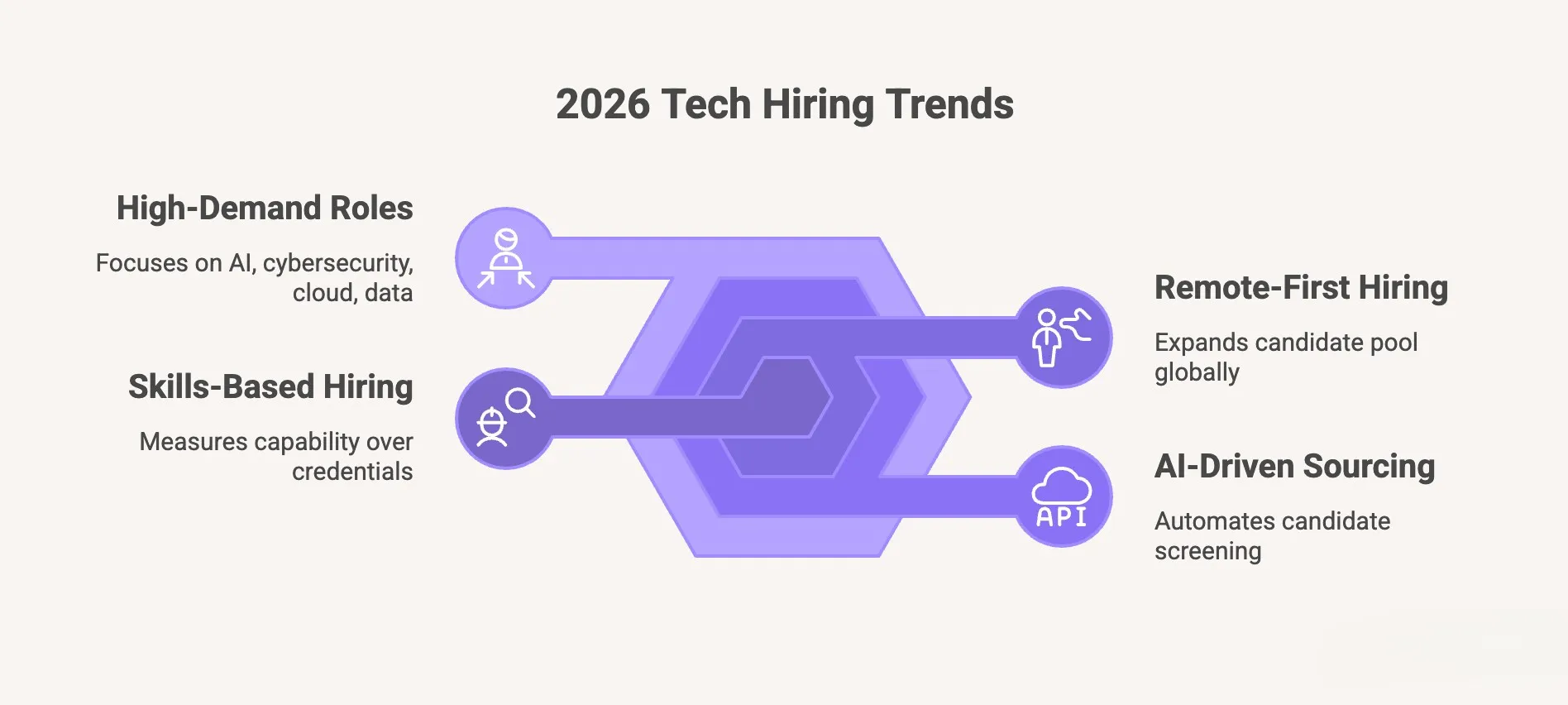
The latest hiring trends in the tech industry point to four clear shifts: AI-driven sourcing is replacing manual screening, demand is concentrating in AI/ML, cybersecurity, cloud, and data roles, remote-first hiring has become the default for most tech positions, and skills-based assessments are replacing credential checks across the board. Each of these trends changes something specific about how you source, evaluate, and close candidates.
The old model was simple: post a job, collect resumes, and screen manually. It was also slow, and honestly, not that accurate. Teams spent weeks sorting through candidates who looked fine on paper but weren't close to what the role actually needed.
AI-driven sourcing shifts by building shortlists from skills signals, work quality indicators, and domain-specific assessments rather than keyword matches on a PDF. You get a smaller, stronger pool of candidates arriving faster.
But pure automation without human judgment just produces speed without signal. The combination of AI precision with recruiter validation is what actually shortens time-to-hire without producing a shortlist you wouldn't trust.
Four positions are pulling the most hiring budget right now: AI/ML engineering, cybersecurity, cloud architecture, and data engineering. These roles are showing up in high volume across company sizes and sectors.
AI-related job titles grew roughly 7x year-over-year. By late 2025, 55% of U.S. tech listings mentioned AI skills requirements, up 84% from December 2024. Cybersecurity holds steady across every industry vertical. Cloud architects and data engineers stay consistently hard to fill, no matter the market conditions.
When it comes to compensation, AI specialist roles pay roughly 8 to 12% over comparable senior engineering positions on average, though this varies by seniority, location, and stage.
Latin American professionals deserve serious attention here. Engineers in Buenos Aires, Bogotá, and Mexico City work in overlapping time zones with U.S. teams, build at world-class levels, and bring cost-to-skill ratios that make scaling a lot more realistic on a lean budget.
Most of the tech roles now list remote options. That means your candidate pool went global, and so did everyone else's competition for the same people. Remote-first hiring works well. Building the operational infrastructure to support it is where most teams fall behind.
But before you open the search globally, get three things in place: payroll and local compliance, standardized contracts, and a timezone overlap policy for roles that need it. An employer-of-record handles the legal and tax side without you setting up entities everywhere. Two to four hours of daily overlap is enough to keep distributed teams connected without turning async work into a scheduling nightmare.
Skills-based hiring is a growing hiring trend in the tech industry, mainly because it changes what you're actually measuring. A degree or job title tells you what someone studied or what they were called at their last company, but a work sample tells you what they can do right now, on work that looks like yours.
The shift starts with the job description. When you focus on the role deliverables rather than listing credentials, candidates self-select more accurately, and interviewers evaluate against the same standard instead of their own version of what "good" looks like.
Assessments follow the same logic. Short take-homes under eight hours, paired programming sessions, and live task interviews reveal genuine capability without exhausting candidates before the offer.
When qualified candidates hold three offers at once, they pick the team with the clearest career path and the most transparent compensation. Not always the highest number, just the clearest one. Publishing salary bands shortens offer cycles, improves how candidates self-select, and tells senior hires that your team actually has its act together.
Retention compounds in ways that are easy to underestimate. Quarterly coaching conversations, published leveling frameworks, and manager training on inclusive feedback reduce the attrition that makes hiring feel like running on a treadmill with the speed set too high. Track offer acceptance and retention by cohort and review the numbers monthly. The patterns show up faster than most teams expect.
Here's a six-step playbook to put these hiring trends into practice. One KPI per step, pilot before you scale, and double down on what actually moves the needle.
The teams that hire well in 2026 won't necessarily carry the biggest budgets. They'll run cleaner processes, write clearer job specs, and look for vetted global talent in markets where the competition is less saturated. Run the playbook this quarter, track your metrics from day one, and adjust based on what the data actually shows.
If you're planning to hire globally to keep up with the latest tech hiring trends, there are several ways to go about it. The safest and fastest path is partnering with a team that finds the right people and handles compliance on your behalf.
Athyna matches ambitious tech teams with vetted global talent using AI precision, delivering curated shortlists in four to five days with cross-border payroll and onboarding built in. Simple, fast, and built for teams that can't afford to wait.
Contact our team and find the best tech talent for your team.
.webp)
Digital Strategist at Athyna, aka the SEO girl.